

Pokémon TCG Pocket Magcargo Deck Guide: Optimal Card Builds, Tactics, and High-Win-Rate Playstyles
In Pokémon TCG Pocket, Fire-type Pokémon have always been a classic favorite for many players. From the original Charizard to various high-burst Fire-type cards, Flame-type Pokémon have always delivered the thrill of intense battles. Among the many Fire-type cards, Magcargo (Lava Cargo) has become a favorite among gamblers with its high-risk, high-reward random damage mechanic.
Although its abilities carry the risk of backlash, with the right deck and the right timing, Magcargo can still create unexpected surprises in a match, catching opponents off guard.
This article will analyze in detail:
Magcargo card features and mechanics
Optimal Magcargo deck builds
Tactical strategies and practical techniques
How to avoid Magcargo's weaknesses and improve your win rate
I. Magcargo Card Introduction: A high-risk, high-reward fire attacker
Magcargo is a Tier 1 Fire-type Pokémon with the following basic stats:
Base HP: 120
Weakness: Water x2 damage
Retreat cost: 3 any Energy (relatively high)
Evolution requirement: Requires Slugma (Lava Snail)
Its core ability is:
Spurt Fire
Cost: 1 Fire Energy + 1 any Energy
Effect: Select a random Pokémon on the field (including your own and your opponent's) three times, dealing 50 damage each time.
Because its attack targets are completely random, you might hit the enemy three times in a single attack (destroying most Basic Pokémon with 150 points of direct damage), or you might accidentally hit your own Pokémon.
This makes Magcargo a highly risky card with surprisingly high burst power.
If there are fewer Pokémon on the field early in the game, the chance of hitting the enemy is greatly increased, making it extremely effective.
II. Magcargo's Pros and Cons
Pros:
High burst damage: Theoretically, a single attack can deal 150 points of damage, instantly killing most low-HP Pokémon.
Disrupts the opponent's rhythm: Its unpredictable attack pattern makes it difficult for the enemy to establish a stable strategy.
Low Energy Cost: It only requires 2 Energy to use its core move, allowing for a fast activation time.
Suitable for stealing points: Deploy it before the enemy has time to build up its main force, allowing it to instantly eliminate key Pokémon.
Disadvantages:
High attack randomness: It may hit your own side, causing damage to your own strength.
Low HP: 120 HP makes it easily killed in the mid-to-late game.
High Retreat Energy: Difficult to safely replace after being crowd-controlled.
Water Vulnerability: Very disadvantaged against major water-type decks (such as Blastoise).
III. Optimal Magcargo Deck Build in Pokémon TCG Pocket
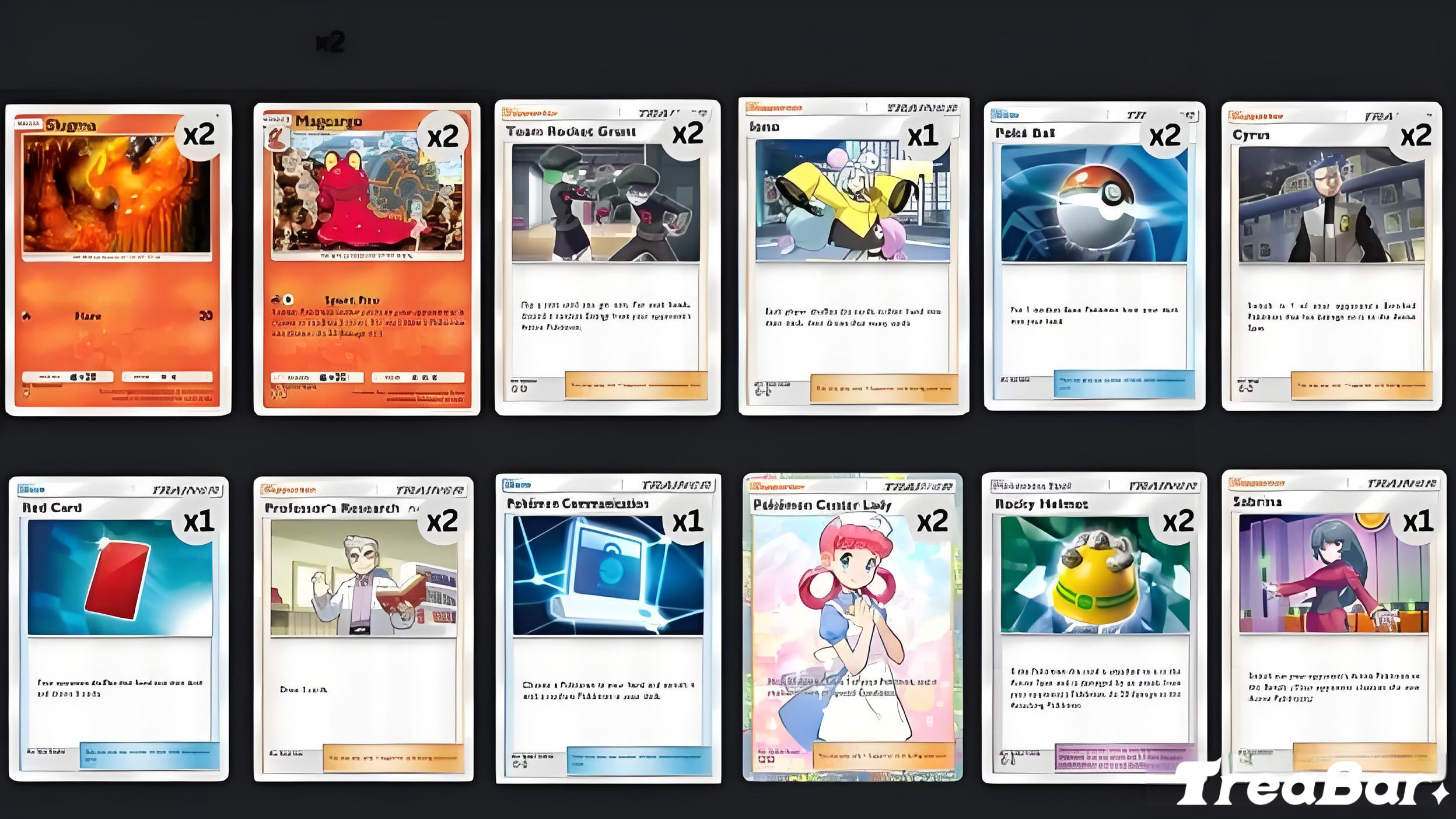
To maximize Magcargo's damage output, we need to minimize the number of Pokémon on the field and increase its survivability. The following is a recommended deck composition (60 cards):
Core Pokémon:
Slugma (Lava Snail) x2
Magcargo (Lava Cargo) x2
Support Cards:
3. Poké Ball x2 (Quickly search for Pokémon)
4. Professor's Research x2 (Quickly draw cards)
5. Rocket Grunt x2 (Slow down the opponent's tempo)
6. Pokémon Center Lady x2 (Restores health and prolongs survival)
7. Rocky Helm x2 (Deal counterattack damage to the enemy)
8. Aino x1 (Resets hand cards)
9. Cyrus x2 (Controls the opponent's bench)
10. Red Card x1 (Disrupts the opponent's hand)
11. Pokémon Communicator x1 (Exchanges required Pokémon)
12. Sabrina x1 (Special Tactics support)
Energy Cards:
Fire Energy x14
Colorless Energy x8
The key to this build is to quickly get Magcargo Enter the game and keep the bench as empty as possible to reduce the risk of accidental damage.
IV. Practical Tactics and Operational Details
Early Game Strategy
Use Poké Balls or Professor's Research to quickly find Slugma and evolve it into Magcargo as soon as possible.
Try not to place extra Pokémon on the bench to reduce the chance of accidental damage.
Use Flamethrower attacks early on to inflict a large number of kills before the enemy's main force evolves.
Mid-Game Control
Use Rocky Helm to reduce the penalty cost for enemy attacks.
Use Cyrus or Red Cards to disrupt the opponent's layout and prevent them from quickly building up energy.
When encountering Pokémon with low HP, Flamethrower's three hits can easily achieve a multi-kill effect.
Late-Game Harvesting
If Magcargo is about to be knocked down, prepare a second Slugma as a backup.
If the enemy Pokémon's HP is generally high, consider temporarily substituting Magcargo and attacking when the enemy's squishy targets appear again.
Risk Control
Only place Slugmas that need to evolve on the bench; keep them empty at other times.
When playing against Water decks, avoid keeping Magcargo on the board for extended periods. It can be used as a surprise attack to snag a kill.
V. Magcargo Matchup Strategy
Against Aggro Deck: Use Magcargo to attack first, leveraging its high burst to preemptively kill key Pokémon and force the enemy to lose tempo.
Against Control Deck: Use a large number of Disruptor Cards (Cyrus, Red Cards) to weaken the opponent's strategic positioning, then look for opportunities to take them down in a single attack.
Against High-Durability Deck: If the opponent's Pokémon has over 200 HP, it's recommended to use Magcargo as a secondary DPS and switch to a more stable Pokémon as the main deck.
VI. Conclusion
Magcargo is a "high-risk, high-reward" card in Pokémon TCG Pocket. It's not for everyone, but for those who enjoy excitement, are willing to gamble, and are adept at mitigating risk through strategy, Magcargo can generate extremely high returns in a game.
If you can:
Control your bench Pokémon
Activate Magcargo quickly and provide ample protection
Unleash Flamethrower at the right time
then this card can become the unexpected killer that crushes your opponent.
Whether playing for fun or climbing the leaderboard, Magcargo can bring unexpected surprises to your battles.